The original Jewish Quarter arose in Buda and thrived during the Turkish reign. Béla IVth Hungarian king, enlisted their financial support to help rebuild
the city after the Mongol and Tatar invasions.
Like elsewhere in Europe, life for Jews alternated between periods of commercial and religious liberties and occasional pogroms.
For example, Jews were briefly expelled from Buda in 1348 because the local Christian residents accused them of spreading the plague.
Later, during the Habsburg rule, Queen Maria Theresa expelled them from whole Buda side, so they began to settle in Pest in the Erzsébetváros district,
which grew into one of the largest Jewish communities in the world before the Holocaust.
Neolog Jews quickly became the backbone of Budapest’s middle-class society — besides commerce, where over 60 percent of Budapest’s merchants were Jewish
in 1910, Jews were over-represented in medicine and law.
Also, many Jewish businessmen founded industrial companies that laid the foundations of modern capitalist corporate culture, for example by offering
generous social benefits. Jews were punching above their weight in arts and sciences, too. Ironically, many of them became internationally known only
after they fled the increasingly anti-Semitic Hungary in the 1930s.
Hungary’s Jewish population before World War II: 825000; the number of Hungarian Jews that perished in the Holocaust: 565000, Here we need to mention
those thousands of survivors who left the country immediately after the war and later, during the Hungarian Revolution of 1956. Few people know that Satmar
hasidic Jews, one of the largest orthodox groups in the U.S. today, originate from Hungary.
Now, with an estimated population of 80000, Budapest is still home to by far the largest Jewish community in Central and Eastern Europe.
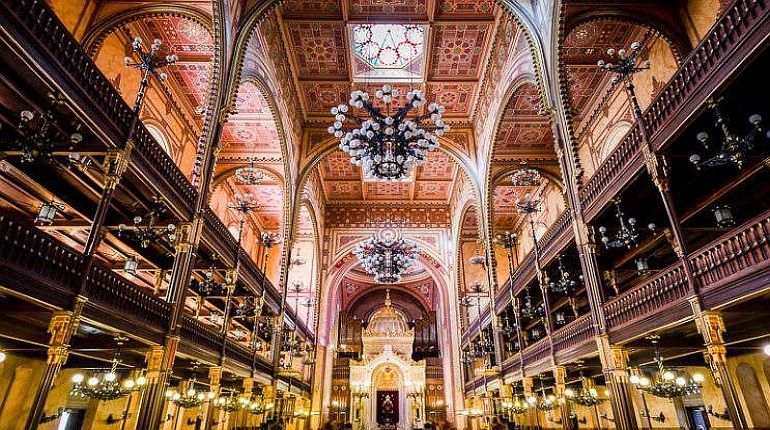
Since less than 10 percent of them are practicing, this is only visible during the High Holidays when the enormous Dohány Street Synagogue fills to capacity,
to show us the real -